

With the 4th quarter of 2022 in full swing, eye-opening data on this year’s leading e-commerce software platforms are in – and some pretty big shifts have happened over the past year.
BuiltWith’s October 2022 survey has found that WooCommerce Checkout continues to sit at the top spot of preferred e-commerce platforms for the internet’s Top 1 million sites, dominating with a 25% marketshare. This is followed by Shopify with 19%, Magento in third at 8%. Compared to August of this year, both WooCommerce Checkout and Shopify both experienced a 1% drop in the marketshare.
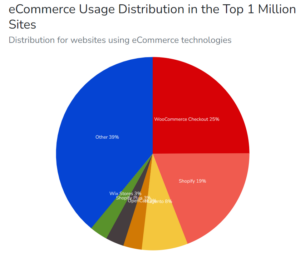 https://trends.builtwith.com/shop
It’s no surprise that WooCommerce is a popular choice among e-commerce businesses – it’s flexible, open source, and comes as a free plug-in for WordPress, which already powers nearly half of all websites on the Internet. It’s a logical choice to add customizable e-commerce capabilities to an already-existing WordPress site and likely offers a more economical yet very functional option for new or smaller businesses.
This is not to say Shopify has performed any less excellently in the over the past year. According to their blog, the platform nearly tripled its revenues in two years, making a total of $4.6 Billion in 2021. Sales on the platform also saw an impressive increase, with their merchants generating a collective total of $175.4 billion in sales by the end of 2021 – 47% higher than 2020’s total sales figure.
That said, the usage distribution of these platforms in the U.S. tell a different story. With over 11 million websites located in the U.S., 25% use Shopify and 22% use Wix Stores. WooCommerce places third at 18%, with relatively newcomer SquareSpace also holding a significant market share at 12% in fourth.
 https://trends.builtwith.com/shop/country/United-States
It’s important to note that the number of businesses continues to grow. In the US alone, the Census Bureau reported 5.4 million applications filed in 2021 – the highest to date – which has likely contributed to the growing number of e-commerce businesses. There are an estimated 12 million–24 million e-commerce websites online – however, only less than 1 million generate more than $1,000 in sales per year.
What Do All These Numbers Mean?
Small businesses make up 99.9% of all businesses in the US, including a growing number of startups as more people leave the labor force to begin betting on themselves. However, the survival rate for new businesses goes down as each year passes. On average, only 80% of new businesses survive their first year – 50% after five years. By the 10th year, only 35% remains.
There are many factors that can contribute to why a business fails. Having a solid business plan backed by sound market research, plus applying the appropriate marketing strategy remains essential for a higher chance of entrepreneurial success.
As more businesses emerge, so will more websites. However, comparing the market shares of the leading e-commerce platforms to their usage statistics in the top 1 million websites leads us to conclude that a platform’s market share does not always equate to revenue generation.
Popularity isn’t bad – each platform has its pros and cons. There’s also a reason why many prefer a particular e-commerce platform over another – most of the time, considerations include how it can integrate with or streamline your business processes, its flexibility for customizability, and ease of navigation both on the front and back ends, among others.
Building a website that’s designed to help you achieve your business goals and facilitate growth should be more than just jumping on the bandwagon of the most popular e-commerce platform. There needs to be a serious consideration when choosing the ideal platform for an e-commerce business.
The Future Of E-Commerce
The e-commerce industry saw explosive growth during the pandemic – but shows no signs of slowing down. Just last year, the e-commerce industry generated 4.9 Trillion USD in sales around the world – and according to Statista, it’s projected to reach $7.4 trillion by 2025.
As entrepreneurs continue to look for ways impactful and sustainable ways to enhance the customer experience, the scope of e-commerce also continues to expand across multiple channels – including mobile apps, social media, marketplaces, and more. A rise in the popularity of the subscription model also reflects an increase in the preference for a more viable supportive relationship between developers and website owners.
In the increasingly hybrid world brought on by the pandemic, the Internet saw exponential growth – as much as 90% – in the past two years. The momentum cloud computing gained during this period has also brought with it some notable shifts in technology used in e-commerce, namely pushing Software as a Platform (SaaS) and Progressive Web Apps (PWAs) into the mainstream.
SaaS can help provide highly nuanced functionalities that can enhance business processes while reducing IT costs and responsibilities and/or create a unique customer experience. Think of it as a program you use to deliver a service or manage your business, but instead of running in on a physical computer, it runs virtually and can be accessed from anywhere you can get an Internet connection. These include cloud-based CRM systems for sales, ticketing systems for customer support, and more. Everyday examples you may not be aware of as SaaS are Google and Facebook. Two major e-commerce platforms are also built on SaaS – Shopify and BigCommerce.
As more people switch to using mobile phones for online purchases – in the United States, this accounts for the purchasing behavior of 82% of Internet users – PWAs are offering more comprehensive and impactful ways to connect with and engage customers. PWAs offer many functionalities and the ease of use of a mobile app while removing the need to download a native app on a mobile device.
How Nexus Box Can Help
Nexus Box is an e-commerce development and marketing agency that provides a comprehensive approach to growing modern businesses – from developing custom websites, mobile apps, and other technology-based solutions that can help you take your business to the next level to creating seamless integrations with your existing system/s to help streamline your business processes and boost productivity. We have over 20 years in the e-commerce industry and we’re proud of the reputation we’ve built in mobile app development and our skills and proficiency in working on SaaS and PWAs.
We continue to stay on the leading edge of technology with continuous innovation and out-of-the-box thinking, working alongside our team of developers that comprises certified Magento, BigCommerce, and Shopify developers, WordPress and WooCommerce specialists, as well as other senior developers with 10+ years of extensive experience in e-commerce development.